
What Is Content Silo Architecture and Why It Matters for SEO
Content silos organise your website into topical clusters that Google rewards. Learn how pillar pages, supporting content and internal linking work together.

Most small business websites are a mess.
They might look great visually.
But structurally? They are often a jumble of pages with no clear organisation.
Blog posts sit in a random list. Service pages aren’t connected to anything.
Google crawls the site and has no idea what the business is actually an authority on.
That isn’t just a housekeeping issue. It is a revenue problem.
What Is Content Silo Architecture and Why It Matters for SEO is about fixing this foundation.
We use this specific structure to turn confused websites into lead-generating machines.
What Is a Content Silo?
A content silo is a method of grouping your website content into distinct, tightly themed sections.
Each group, or silo, covers one core topic thoroughly.
You have a main page (called a pillar page) at the top.
Underneath that, you have several supporting pages (usually blog posts) that link back to the main page.
Think of it like the aisles in a Bunnings warehouse.
You don’t find power drills mixed in with the potting mix.
Everything is grouped by category.
If you are in the paint section, you find brushes, rollers, and drop sheets right next to the cans of paint.
That is exactly what a silo does for your website architecture.
Why Google Cares About Structure
Google’s primary goal is to organize the world’s information.
When your content is sorted into clear topical groups, you make that job significantly easier.
You are effectively telling the search engine:
“This section of my site is about plumbing. Here is our main plumbing page, and here are ten articles that go deeper into specific plumbing topics.”
Google sees that structure and recognizes expertise.
This concept is known as Topical Authority.
It is one of the strongest ranking signals in modern SEO.
Sites that cover a topic in depth outrank sites that just touch on it superficially.

The Three Parts of a Content Silo
A successful silo isn’t complicated.
It relies on three specific components working together.
1. The Pillar Page
This is the foundation of the silo.
It covers the core topic broadly and links down to supporting content for the details.
A pillar page is typically longer than a regular page.
We usually aim for 1,500 to 3,000 words for these assets.
It serves as the definitive resource on that topic for your site.
For a web design business, a pillar page might be titled “SEO Web Design for Small Businesses.”
It would cover what it is and why it matters.
Then, it would link to deeper articles on specific aspects like page speed, content strategy, and local SEO.
This page converts visitors into leads.
For more on how pillar pages work, check out our post on pillar pages explained.
2. Supporting Content (Cluster Content)
These are your blog posts, guides, and articles.
They go deep on specific subtopics within the silo.
Each piece of supporting content targets a specific long-tail keyword and always links back to the pillar page.
If your pillar page is “Home Renovation,” your supporting content must be specific.
Topics might include:
- Kitchen renovation costs in Sydney
- Council permit requirements
- Choosing the right builder
- Bathroom layout ideas
These posts attract traffic from specific questions people ask Google.
3. Internal Links
This is the glue that holds the structure together.
Internal links connect the pillar page to the supporting content and vice versa.
They also connect related supporting articles to each other within the same silo.
These links pass authority (often called “link juice”) between pages.
They help Google understand the relationship between your content.
Proper linking also keeps visitors on your site longer by offering them relevant next steps.
We have written a detailed guide on internal linking strategy if you want to understand the mechanics.
What a Content Silo Looks Like in Practice
Let’s look at a concrete example.
Imagine you run a plumbing business in Sydney.
Here is how we would structure your silos to dominate local search results:
Silo 1: Emergency Plumbing
- Pillar Page: 24/7 Emergency Plumbing Services Sydney
- Supporting Content:
- “What to Do When a Pipe Bursts at Night”
- “How to Shut Off Your Water Main”
- “Emergency Plumber Costs in Sydney (2025 Guide)”
- “5 Signs You Need Immediate Plumbing Help”
Silo 2: Bathroom Renovations
- Pillar Page: Complete Bathroom Renovation Services
- Supporting Content:
- “Average Bathroom Renovation Costs Sydney”
- “Timeline: How Long Does a Bathroom Reno Take?”
- “Small Bathroom Design Ideas for Apartments”
- “Ceramic vs. Porcelain: Choosing Bathroom Tiles”
Silo 3: Blocked Drains
- Pillar Page: Blocked Drain Cleaning & Repairs
- Supporting Content:
- “How to Unblock a Drain Without Chemicals”
- “Why Tree Roots Block Drains in Older Suburbs”
- “CCTV Drain Inspection Explained”
- “High-Pressure Jet Blasting vs. Electric Eels”
Each silo is self-contained.
The pillar page links to all its supporting posts.
Every supporting post links back to the pillar.
Posts within the same silo link to each other where relevant.
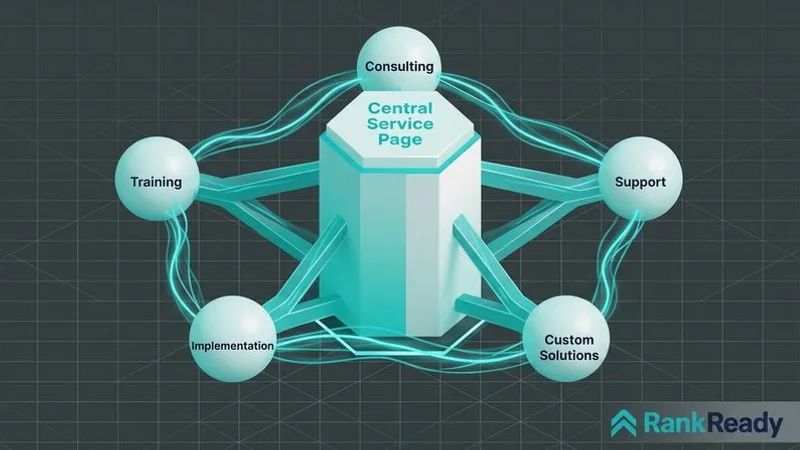
Flat vs. Siloed: A Comparison
Most business owners don’t realize their site is “flat” until they see the difference in performance.
A flat website places all pages at the same level with no clear grouping.
This sends weak signals to Google.
There is no topical depth.
Here is the practical difference in performance:
| Feature | Flat Site Structure | Siloed Site Structure |
|---|---|---|
| Organization | 20 random posts linking only to the home page. | 20 posts grouped into 4 distinct topics. |
| User Journey | Users read one post and leave (Dead end). | Users click through to related articles (Path). |
| Keyword Focus | General keywords with high competition. | Specific, long-tail keywords with high intent. |
| Google View | ”This site mentions plumbing occasionally." | "This site is an authority on plumbing.” |
| Indexing Speed | Slow. Google struggles to find new pages. | Fast. Links guide bots to new content instantly. |
The content might be exactly the same.
The number of pages could be identical.
But the siloed version ranks significantly better because Google understands the context.
How to Build Content Silos on Your Website
You do not need to delete your current site to fix this.
We recommend a four-step process to reorganize what you already have.
1. Map Your Core Topics
Start with your main revenue drivers.
Each service or product category becomes a silo.
Most small businesses have three to six core topics.
Do not overcomplicate this step.
If you sell air conditioning, your silos might be “Installation,” “Repairs,” and “Commercial HVAC.”
2. Audit and Assign Existing Content
Review your existing blog posts.
Assign every single post to one of your core topics.
If a post doesn’t fit any of your core services, ask yourself if it is worth keeping.
Irrelevant content dilutes your authority.
3. Create or Improve Your Pillar Pages
Each silo needs a strong parent page.
If you already have service pages, expand them.
Make sure they cover the topic broadly.
Include relevant keywords naturally.
Most importantly, add a section specifically for linking to your supporting content (e.g., “Related Articles” or “Learn More About Renovations”).
4. Implement Internal Linking
This is the step most people skip.
It is also the most critical for SEO performance.
Go into every supporting post and add a link back to the pillar page.
Use descriptive anchor text.
Instead of “click here,” use “contact our emergency plumbing team” or “read our guide on bathroom renovations.”
5. Keep Silos Mostly Separate
Avoid excessive cross-linking between different silos.
A few contextual links between “Bathroom Renovation” and “Plumbing” are fine.
However, the bulk of your internal links should stay within the same topical group.
This keeps the thematic signal strong for Google.
The SEO Impact of Proper Silos
We track the data on this architecture across dozens of client sites.
When implemented correctly, the results are measurable and significant.
- Pages rank faster: New content benefits from the existing authority of the silo.
- Keyword dominance: You start ranking for dozens of specific variations of your main keywords.
- Lower bounce rates: Visitors find related content easily and stay on the site.
- Higher conversion rates: By the time a user reaches your service page, they have read your expert articles and trust you.
The Bottom Line
Content silo architecture isn’t a temporary trend.
It is simply smart information organization.
You group related content together.
You connect it with internal links.
You build genuine depth around the topics that make you money.
The result is a website that Google understands, trusts, and rewards with better rankings.
For your visitors, it creates a site that actually helps them find the answers they need.
This is exactly the kind of structure we build into our authority website package.
A site shouldn’t just look good.
It must be engineered to build authority and win in competitive markets.
Need a Rank-Ready Website?
Get an SEO-optimised website for your Sydney business — live in days, from $1,497.
Get Started